
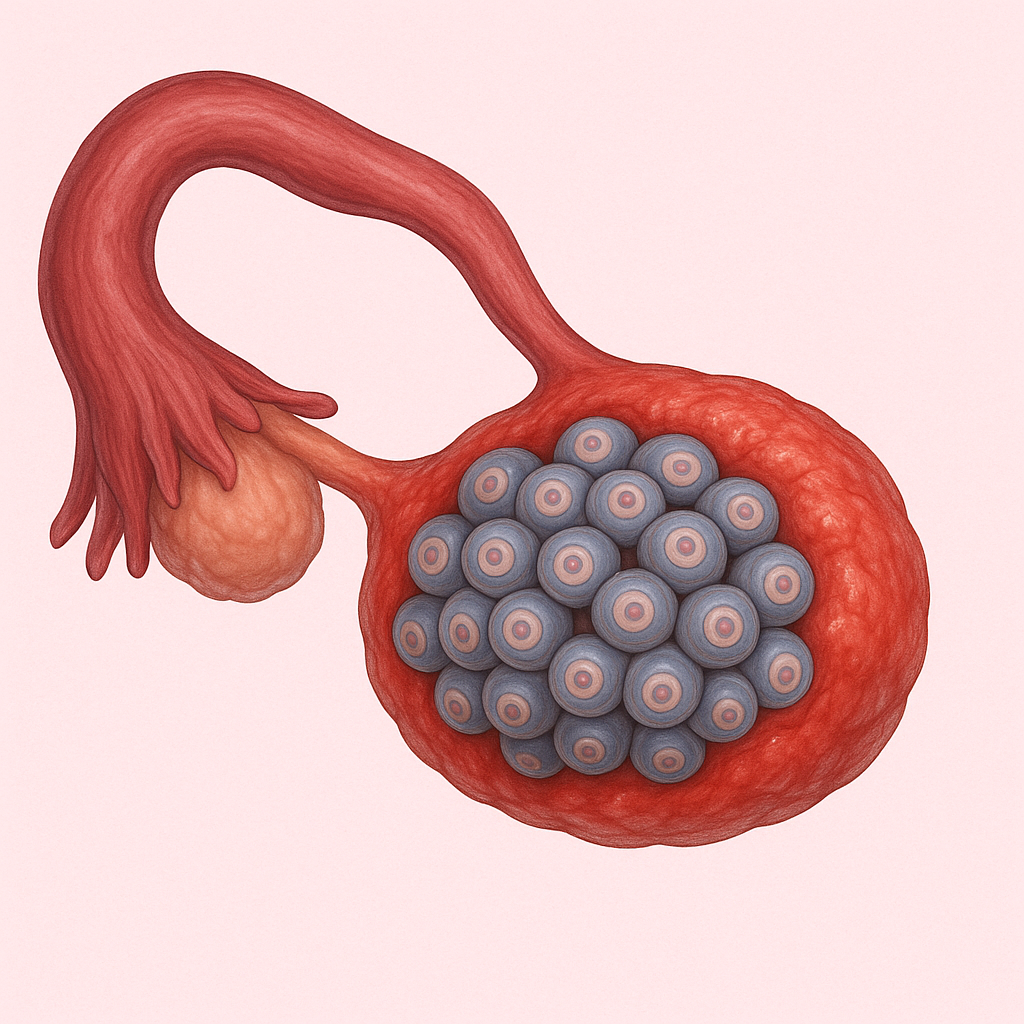
Ovarian hyperstimulation syndrome: Why even the best prevention strategy doesn’t eliminate risk
What my research shows about OHSS in high-risk IVF patients – and why individualised monitoring matters
If you’re preparing for IVF, your specialist may have spoken to you about ovarian hyperstimulation syndrome, or OHSS. It’s one of the more serious potential complications of IVF treatment, and preventing it is something I think about carefully with every patient I treat.
OHSS occurs when your ovaries over-respond to the fertility medications used during IVF stimulation. In mild cases it causes bloating and discomfort. In severe cases it can require hospitalisation, which is why managing that risk is critical when planning a safe IVF cycle.
The current best-practice approach
For several years, the standard approach for high-risk patients has been to use a GnRH agonist trigger injection rather than the traditional HCG trigger, combined with freezing all eggs or embryos rather than doing a fresh transfer. This approach significantly reduces the risk of severe OHSS and is now widely used in evidence-based fertility practice.
But does it eliminate the risk entirely? That’s the question my research team set out to examine.
What the research found
In a study published in the Australian and New Zealand Journal of Obstetrics and Gynaecology in November 2025, we reviewed five years of hospital admission data on patients with severe OHSS. What we found was important: while the GnRHa trigger dramatically reduces risk, it does not eliminate it.
Of 150 severe cases of OHSS requiring hospital admission, 16 per cent – that’s 24 women – occurred in patients who had already received the GnRHa trigger. These women tended to have significantly higher egg reserves and more eggs retrieved than those who developed OHSS after the standard trigger.
Let me translate what this means in practical terms.
What this means for you as a high-risk patient
The good news is that the GnRHa trigger with freeze-all protocol remains the most effective prevention strategy we have. For the vast majority of high-risk women, this approach prevents severe OHSS from developing.
But the research shows that some high-risk women remain vulnerable even with this best-practice approach in place. These tend to be women with exceptionally high egg reserves – indicated by very high AMH levels – and those who produce very large numbers of eggs during stimulation.
If you fall into this category, you need to know this upfront. A one-size-fits-all approach is never appropriate when the stakes are this high.
Why some women still develop severe OHSS
The women in our study who developed OHSS despite receiving the GnRHa trigger had baseline characteristics that were remarkably similar to those who received HCG triggers. What set them apart was their underlying fertility profile: much higher AMH levels and higher numbers of eggs retrieved.
This tells me that egg reserve and ovarian response to stimulation are critical factors in determining who remains at risk, even with the best prevention strategy in place.
What careful, individualised monitoring means for your cycle
If you’re identified as high risk for OHSS – particularly if you have a high egg reserve or polycystic ovaries – this research reinforces why your monitoring throughout the IVF cycle needs to be meticulous and personalised to your specific situation.
This means regular blood tests and ultrasounds during stimulation to track how your ovaries are responding in real time. It means being prepared to adjust medication doses if your response is unusually strong. It means discussing the freeze-all protocol in detail and understanding why that approach protects you. And it means knowing the warning signs of OHSS so you can seek help immediately if symptoms develop.
Why this research matters
When I reviewed the literature on OHSS prevention before conducting this research, many studies suggested that severe OHSS could virtually be eliminated using the GnRHa trigger. That’s a reassuring message, but our data shows it’s not entirely accurate. The literature may have underestimated the risk in the highest-risk patients – those with the most extreme fertility profiles.
By identifying that 16 per cent of severe cases still occurred despite best-practice prevention, we’re highlighting an important gap. These women are not failures of the system. They represent a population that may require additional preventative strategies or even more intensive monitoring.
What happens next
The conclusion of our research is clear: using a GnRHa trigger and freeze-all protocol reduces but does not eliminate OHSS in high-risk women. This means further preventative strategies may be necessary for this specific population.
That’s why my approach to every high-risk patient is to discuss their individual risk profile in detail before we start stimulation. I want you to understand your specific risk factors, know what we’re doing to prevent complications, and be prepared for what careful monitoring will look like throughout your cycle.
If severe OHSS does develop despite all our efforts, you’ll be monitored closely in hospital with supportive care. But the goal is always to prevent it from developing in the first place – and the more we understand about which patients remain at risk even with best-practice prevention, the better we can protect you.
Your role in managing your risk
You also have an active role in managing your OHSS risk. This means reporting symptoms promptly – rapid weight gain, abdominal bloating and pain, nausea or vomiting, decreased urination. It means being honest about your concerns during monitoring appointments. And it means asking questions if anything about your cycle response feels unusual.
If you’re preparing for IVF and have questions about OHSS risk in your specific situation, I’d encourage you to discuss this in detail during your consultation. Understanding your individual risk and the strategies we’ll use to manage it is an essential part of planning a safe cycle.